
Vibe Coding 101 : Complete Guide
Everything you need to know about vibe coding.

In this blog, I share what vibe coding is and how to leverage it as a designer, product manager, or AI product builder. You can watch the video here and continue reading along I’ll also share special hacks that will improve your vibe coding workflows.
Here is full 10 min video
So What is vibe coding ?
What is vibe Vibe Coding ?
Vibe coding refers to the capability of dropping a text prompt into an agent and having that agent generate an entire application or software for you. Historically, building a small prototype, MVP (Minimum Viable Product), or full product involved manually writing code, which was a very time-consuming process.
Now, with vibe coding, you gain significant opportunities to build your own product MVPs and 0 →1 products that you can quickly launch, test with users, and iterate upon. I have personally utilized vibe coding to create my own portfolio, the AI design academy, and currently building UX AI Agent iOS app
Here is behind the scenes of vibe coding my portfolio
Essential Tools and Real-World Impact
The AI tool landscape offers many tools for vibe coding, but my personal favorites include Cursor and Lovable. Other prominent tools in this space are Figma make, which integrates with the Figma workflow, VS code Copilot, antigravity by Google, replit, and V0. When starting out, the recommendation is to choose a tool you find comfortable and approachable.
Vibe coding provides concrete benefits that go beyond just saving time. For instance, I used vibe coding to build a UX AI agent that won a hackathon in San Francisco. Instead of merely showing slides, demonstrating an actual, end-to-end demo of the product including APIs and functionalities is much more effective for gathering feedback and building based on those insights. This approach helps product managers, designers, and AI product builders truly be more human-centric.
Unlocking Opportunities and Workflow Shifts
Vibe coding unlocks exciting opportunities in product development:
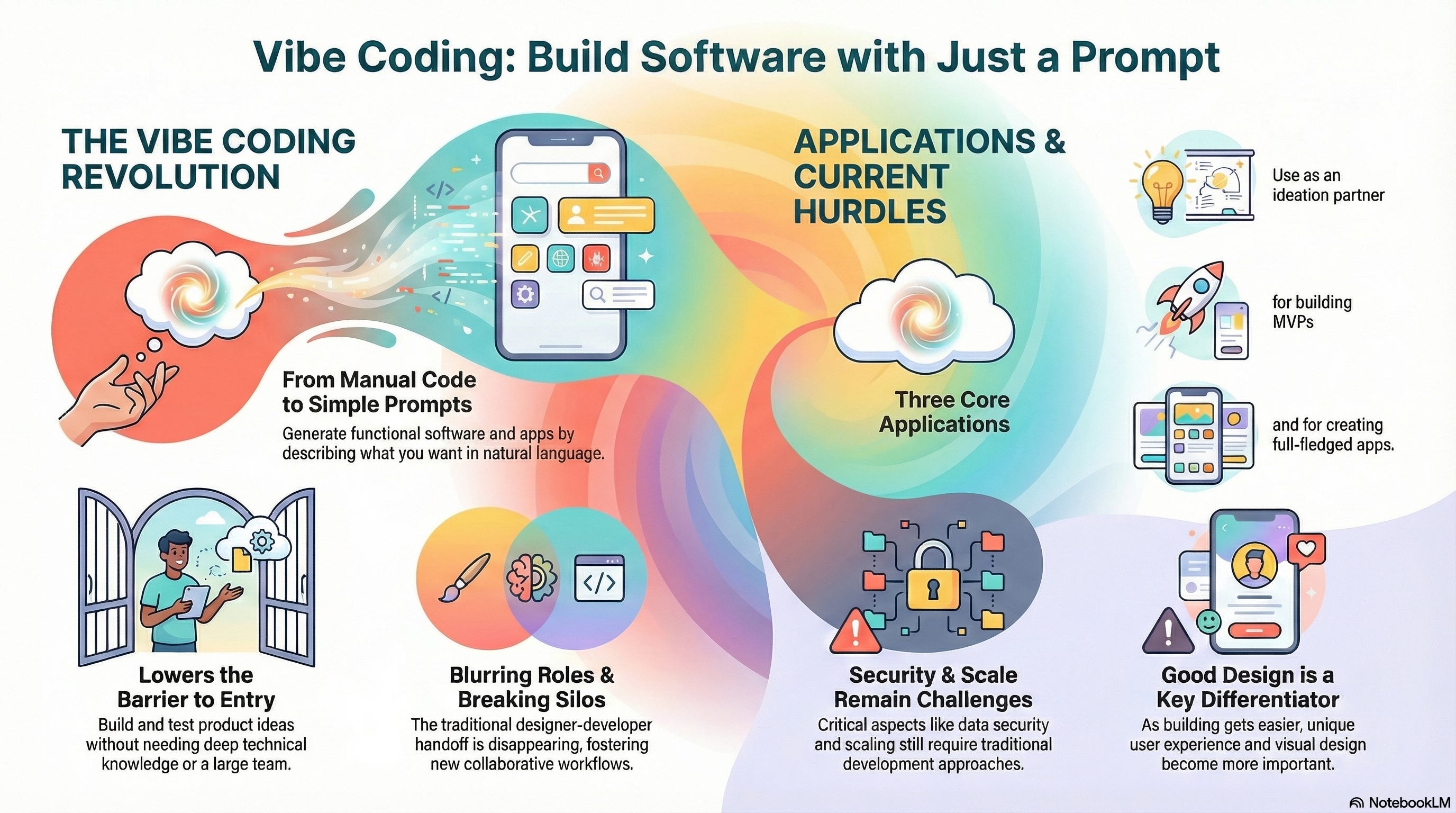
1. Removing Barriers to Entry: It eliminates the need for a expert just to build a basic MVP, thereby quickly lowering the difficulty barrier for anyone with an idea or concept.
2. De-risking Decisions: Product and design teams can now derisk product decisions by quickly building and testing prototypes using simple prompts. This drastically reduces the time, complexity, and engineering effort previously required to evaluate whether a feature or product would work.
3. Eliminating Handoffs: Vibe coding is causing the designer and developer handoff process to fade because the design and front end are becoming integrated. In tools like Cursor, what is designed is what is seen immediately in production, effectively eliminating the handoff entirely. This integration is becoming the norm.
4. Enhanced Collaboration: Although the overlapping roles may initially cause cultural conflicts in big teams, vibe coding is taking out silos and fostering better collaboration by helping individuals understand each other’s roles more effectively. This allows designers, for example, to approach developers or product managers with a functional prototype to refine the product and make it production-ready.
The Three Core Use Cases
I categorize vibe coding into three main use cases:
1. Ideation Partner: Vibe coding serves as an excellent brainstorming partner. When exploring different interaction patterns, such as minimalist versus highly animated elements for a UX AI agent, the AI can assist in brainstorming and generating ideas you might not have considered yourself. It allows you to quickly prototype ideas in plan or agent modes.
2. Building MVPs: It simplifies the process of quickly building out a Minimum Viable Product (MVP) to test if a noticed problem or concept is truly solved by the solution.
3. Building Full-Fledged Apps: Small teams are now capable of building, launching, and even maintaining 0 to 1 AI products. While scaling and long-term maintenance still often require a larger, dedicated team, vibe coding makes the initial launch of full-fledged apps possible. Furthermore, non-technical people can now easily integrate APIs, which used to be a complicated task.
Limitations and the Indispensable Role of Human Direction
Despite the numerous benefits, several limitations must be considered:
• Security and Maintenance: A major limitation is the security part of the app, including data security and privacy. As products scale, maintaining security, compliance, and the overall application still requires a traditional, dedicated team.
• Generic Experiences: Products quickly generated can sometimes feel generic and lack a unique experience. Therefore, UX designers are still vital for thinking through the user experience, ensuring customer connection, and ensuring the product effectively solves the problem.
• Design as a Differentiator: While AI can provide a baseline visual design, design ( both the balance of form and function ) will play a major role in differentiating products. Since building products is getting easier, a better visual design mindset is necessary for a product to stand out. Customers will naturally gravitate toward AI tools they find easier to use or feel more connected with.
• Design System Integration: Seamless design system integration remains a friction point. While tools like V0 use design systems by default (like shadcn), connecting large, enterprise-level design systems to the vibe coding process is currently not seamless, creating a gap for those building hackathons or innovation prototypes.
Ultimately, although AI generates the software quickly from a text prompt, the human element your human direction, thought process, and product thinking remains critically important throughout the iteration process. Your mindset determines the success of the outcome.
Here is quick summarry everythign shared in this article
Thank You For Reading
More Resources
If you’re just getting started: → Grab the free Vibe Coding Guide
If you’re ready to level up your vibe coding skills & AI workflows: → Join the next 2-week live cohort
